

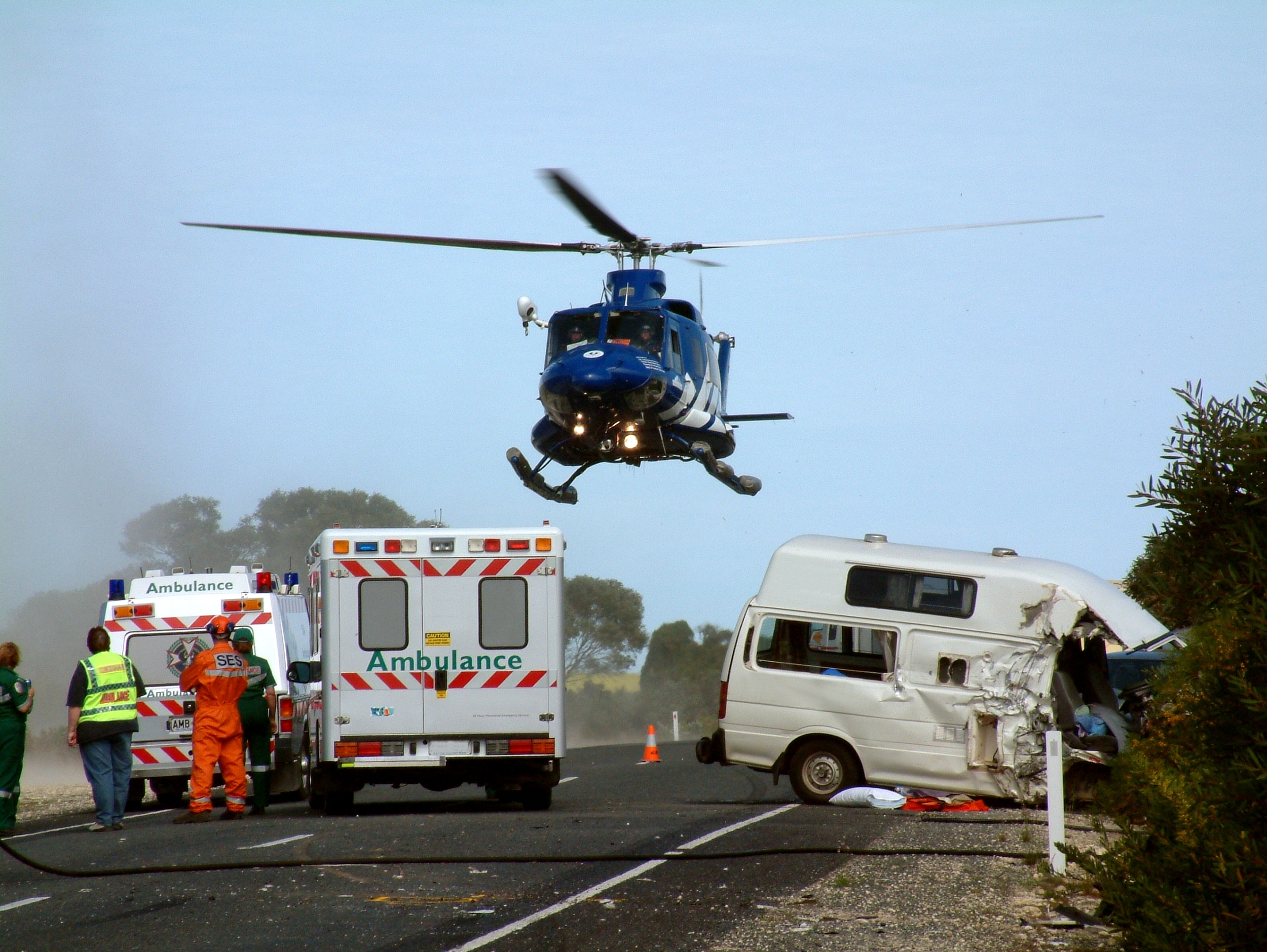
Patient Dies After Ambulance Rolls Over in Crash at Van Dyke and Metropolitan Parkway [STERLING HEIGHTS, MI]

A 36-year-old man died at a hospital after an ambulance transporting him was struck by an SUV and overturned Sunday evening, October 25, 2026, in Sterling Heights. Authorities have not publicly established whether the collision contributed to his death.
The Sterling Heights ambulance crash occurred at Van Dyke Avenue and Metropolitan Parkway, and two other people were injured.
What Happened in the Sterling Heights Ambulance Crash
Sterling Heights police said they received reports of a serious multi-vehicle collision at approximately 6:30 p.m. Sunday at Van Dyke Avenue and Metropolitan Parkway, also known as 16 Mile Road.
Initial reports indicated that one person was unconscious at the scene.
According to the preliminary investigation, an Aspire Health System ambulance was traveling south on Van Dyke with its emergency lights and siren activated.
As the ambulance entered the intersection, a black 2025 Jeep Grand Cherokee struck the right side of the ambulance’s rear patient compartment.
The force of the collision caused the ambulance to roll over before coming to rest on its wheels.
Two crew members and one patient were inside the ambulance.
The patient, a 36-year-old man from North Branch, was transported to a hospital, where he died.
Because the man was already receiving emergency medical care before the collision, the available reports do not establish whether his death resulted from the crash, his underlying medical condition, or a combination of factors.
The paramedic caring for the patient in the rear compartment suffered moderate injuries.
The ambulance driver was not injured.
The Jeep’s driver was also taken to a hospital with injuries described as non-life-threatening.
Police said they did not suspect alcohol or drugs contributed to the collision.
However, investigators are still working to determine the circumstances leading up to the crash, and authorities have not released the names of those involved.
A Sterling Heights police official told WXYZ that Van Dyke and Metropolitan Parkway is a known problem intersection and that the department is working to improve safety there.
Police Ask Witnesses to Come Forward
Sterling Heights police are asking anyone who witnessed the collision or has information about the circumstances to contact Officer Porter of the Sterling Heights Police Traffic Safety Bureau at 586-446-2920.
Information from witnesses may help investigators establish the sequence of events and determine how the collision occurred.
Why Crashes Involving Emergency Vehicles Are So Dangerous
Ambulances and other emergency vehicles sometimes need to travel through busy intersections while responding to emergencies or transporting patients.
Depending on the circumstances, emergency vehicle drivers may need to proceed through an intersection against a traffic signal while complying with applicable safety requirements.
These situations can create significant risks.
Other motorists may have difficulty hearing sirens over traffic noise or music, seeing emergency lights, or determining the direction from which an emergency vehicle is approaching.
Wide intersections and multiple traffic lanes can make these situations particularly challenging.
People riding in the rear of an ambulance may face additional hazards during a collision.
Patients are often secured to stretchers, while paramedics may need to move within the compartment to provide medical care.
A side-impact collision or rollover can expose occupants to sudden forces, contact with equipment, and other injury risks.
Van Dyke Avenue and Metropolitan Parkway is a major intersection where two heavily traveled, multi-lane roads meet.
The roadway configuration makes awareness and appropriate yielding especially important when emergency vehicles are approaching.
Common Injuries in Side-Impact and Rollover Crashes
Police described the paramedic’s injuries as moderate and the Jeep driver’s injuries as non-life-threatening.
Side-impact and rollover collisions can cause a range of injuries depending on the vehicles involved, occupant positions, and impact forces.
Potential injuries include:
- Traumatic brain injuries: Occupants may strike vehicle interiors, equipment, or other surfaces during a collision.
- Neck and spinal injuries: Sudden movement and rollover forces can cause strains, fractures, or spinal cord injuries.
- Broken bones: Arms, ribs, shoulders, hips, and legs may be injured during significant impacts.
- Internal injuries: Side-impact forces may cause injuries to the chest, abdomen, or internal organs.
- Cuts and bruises: Broken glass, airbags, and displaced equipment can cause additional injuries.
Some symptoms may not become noticeable immediately after a collision.
Anyone experiencing pain, dizziness, head injury symptoms, or other concerning changes should seek prompt medical evaluation.
Serious or worsening symptoms require emergency attention.
Michigan’s Emergency Vehicle Laws
Michigan law establishes responsibilities for motorists when authorized emergency vehicles approach.
It also sets conditions governing the operation of emergency vehicles responding to emergencies.
The following is general information about Michigan law and does not establish which driver was responsible for Sunday’s collision.
Drivers Must Yield to Emergency Vehicles
Under MCL 257.653, drivers must yield the right of way when an authorized emergency vehicle approaches using the required audible and visual warning signals.
Motorists generally must move as close as possible to the right-hand edge or curb of the roadway, remain clear of intersections, and stop until the emergency vehicle has passed.
Drivers must make these movements safely and comply with the applicable statutory requirements.
Failure to yield as required may result in a civil infraction.
However, whether a motorist violated the law in a particular collision depends on the circumstances and available evidence.
Emergency Vehicle Drivers Must Exercise Due Regard
Emergency vehicle drivers also have responsibilities.
Under MCL 257.603, an authorized emergency vehicle responding to an emergency may proceed through a red light or stop sign after slowing down as necessary for safe operation, subject to statutory conditions.
Emergency driving privileges do not eliminate the driver’s responsibility to exercise due regard for the safety of others.
The applicable warning-device requirements and emergency driving privileges depend on the statutory provisions and circumstances involved.
In Sunday’s collision, police reported that the ambulance was traveling with its emergency lights and siren activated.
However, the investigation remains ongoing, and the available reporting does not establish whether either driver violated Michigan traffic law.
Our article about crashes involving emergency vehicles in Michigan explains these rules and potential liability considerations in more detail.
Legal Options for Injured People and Families
A collision involving an ambulance may raise questions about insurance benefits, driver negligence, employment-related injuries, and potential claims involving a deceased patient.
The applicable legal options depend on the circumstances and evidence.
Michigan No-Fault Benefits
Under MCL 500.3105, qualifying individuals may receive personal protection insurance (PIP) benefits for accidental bodily injuries arising out of the ownership, operation, maintenance, or use of a motor vehicle.
These benefits are generally available without regard to fault.
Depending on the circumstances and applicable coverage, PIP benefits may include medical expenses, wage loss, and certain other covered losses.
In qualifying fatal cases, survivor-related benefits and funeral or burial expenses may also be available, subject to statutory requirements and limits.
However, eligibility is not automatic.
The responsible insurer, available benefits, and applicable coverage depend on Michigan’s insurance priority rules and the circumstances of the injury.
An ambulance crew member injured while performing job duties may also qualify for workers’ compensation benefits.
Workers’ compensation and no-fault benefits can interact under Michigan law, including applicable coordination provisions.
Determining the available benefits requires evaluating the circumstances rather than assuming that both systems will provide full payment.
Claims Against an At-Fault Driver
When a motor vehicle collision causes serious injuries or death, an injured person may have a claim against a legally responsible driver.
Under MCL 500.3135, qualifying noneconomic damages may be recoverable when an injury results in death, serious impairment of body function, or permanent serious disfigurement.
Establishing such a claim requires consideration of negligence, causation, damages, and other applicable legal requirements.
Michigan’s comparative fault provisions, including MCL 600.2959, may affect recoverable damages when responsibility is shared.
In collisions involving emergency vehicles, investigators may examine the actions of both drivers, traffic signals, warning devices, vehicle speeds, and other evidence.
No final determination of fault has been reported in the Sterling Heights ambulance collision.
A Sterling Heights personal injury attorney can help injured individuals understand the legal requirements and potential claims that may apply.
Wrongful Death Claims
Michigan law allows certain claims when another party’s wrongful conduct legally causes a person’s death.
Under MCL 600.2922, a wrongful death action may be brought by the personal representative of an estate when evidence establishes that another party’s wrongful act, neglect, or fault caused the death.
Because the patient involved in Sunday’s collision was already receiving emergency medical care, whether the crash contributed to his death would be an important question in evaluating any potential wrongful death claim.
The fact that a death occurred after a collision does not, by itself, establish that the collision legally caused the death.
Medical evidence, the patient’s condition before the crash, and other investigative findings may be relevant.
Many wrongful death lawsuits arising from negligence are subject to a three-year limitations period under MCL 600.5805, although exceptions and other statutory requirements may apply.
Families can learn more about wrongful death claims in Sterling Heights and the legal considerations involved.
What Families Can Do After a Fatal Crash
Losing a loved one while they are receiving emergency medical care can leave families facing difficult questions about what happened.
When a collision occurs during ambulance transportation, understanding the sequence of events and preserving relevant records may be important.
Several steps may help families obtain information and protect potential legal options.
- Stay in contact with investigators. Ask which agency is investigating and how to obtain the crash report when available.
- Identify applicable insurance coverage. Notify the appropriate insurer promptly and ask about relevant benefit and filing requirements.
- Preserve medical and expense records. Keep available documentation involving medical treatment, transportation, and funeral expenses.
- Document known circumstances. Record information about the ambulance trip, the patient’s condition before the collision, and any communications received.
- Seek appropriate guidance. A trusted family member or attorney may help manage communications with insurers and other involved parties.
Families should avoid assuming that the collision caused the death until the relevant medical and investigative evidence has been evaluated.
How to React When an Emergency Vehicle Approaches
Drivers can help reduce collision risks by remaining attentive and responding appropriately when emergency vehicles approach.
- Stay alert for warning signals. Keep music and other distractions at a level that allows you to notice sirens and surrounding traffic.
- Check intersections carefully. Look for approaching emergency vehicles before entering an intersection, even when your traffic signal is green.
- Yield safely. Move toward the right edge of the roadway and stop as required by Michigan law when an authorized emergency vehicle approaches.
- Keep intersections clear. Avoid stopping within an intersection or making sudden movements that create additional hazards.
- Watch for additional emergency vehicles. Another emergency vehicle may be following the first.
- Resume driving only when safe. Make sure the emergency vehicle has passed and the roadway is clear before continuing.
Following these precautions can help motorists respond safely and predictably when ambulances, fire trucks, or police vehicles approach.
Frequently Asked Questions
What does Michigan law require when an ambulance approaches?
Under MCL 257.653, motorists generally must yield to an authorized emergency vehicle approaching with the required audible and visual warning signals. Drivers must move as close as possible to the right edge or curb, remain clear of intersections, and stop until the emergency vehicle passes, subject to the statute’s requirements.
Can an ambulance go through a red light in Michigan?
Yes, under certain circumstances. MCL 257.603 permits authorized emergency vehicles responding to emergencies to proceed through red lights or stop signs after slowing as necessary for safe operation, subject to statutory conditions. Emergency drivers must still exercise due regard for the safety of others.
Who pays medical bills for people injured in an ambulance crash?
Michigan no-fault PIP benefits may cover qualifying medical expenses, depending on the circumstances, insurance priority rules, and available coverage. Ambulance crew members injured while working may also qualify for workers’ compensation benefits. Coordination rules can affect the benefits payable under each system.
Can a family file a wrongful death claim after an ambulance crash?
Possibly. Under MCL 600.2922, a wrongful death action may be available when evidence establishes that another party’s wrongful conduct legally caused the death. Because the patient in Sunday’s collision was already receiving emergency medical care, the relationship between the crash and his death would require careful evaluation.
How long does a family have to file a wrongful death lawsuit in Michigan?
Many negligence-based wrongful death lawsuits are subject to a three-year limitations period, although exceptions may apply. No-fault benefit claims have separate notice and filing requirements, including deadlines under MCL 500.3145. The applicable deadline depends on the claim and circumstances.
Our thoughts are with the family and friends of the North Branch man who died following Sunday’s ambulance collision, and we wish the injured paramedic and Jeep driver a full recovery.
The crash at Van Dyke Avenue and Metropolitan Parkway demonstrates the serious consequences that can follow collisions involving emergency vehicles, particularly when patients are being transported for medical care.
The attorneys at Macomb County Accident Attorneys help injured individuals and grieving families throughout Sterling Heights and Macomb County understand their legal options after serious accidents.
If you have questions about a collision, insurance benefits, or a potential injury claim, contact our office to discuss your circumstances.
Source: ClickOnDetroit
Note: Our law office relies on external sources for the content of this post. Although we aim for accuracy, we have not independently verified all facts related to this incident. Please notify Mihelich & Kavanaugh, PLC for corrections if you identify any inaccuracies. Posts will be removed upon request.
Disclaimer: The content of this post is intended for informational purposes only and does not constitute a solicitation for business. The information contained herein is not intended to offer legal or medical advice. If you or someone you care about has been injured in an accident, it is recommended to seek immediate medical assistance. The photo featured in this post was not taken at the actual scene of the accident.
Van Dyke Avenue and Metropolitan Parkway (16 Mile Road) in Sterling Heights, Michigan, where an ambulance overturned following a collision with a Jeep on October 25, 2026.